
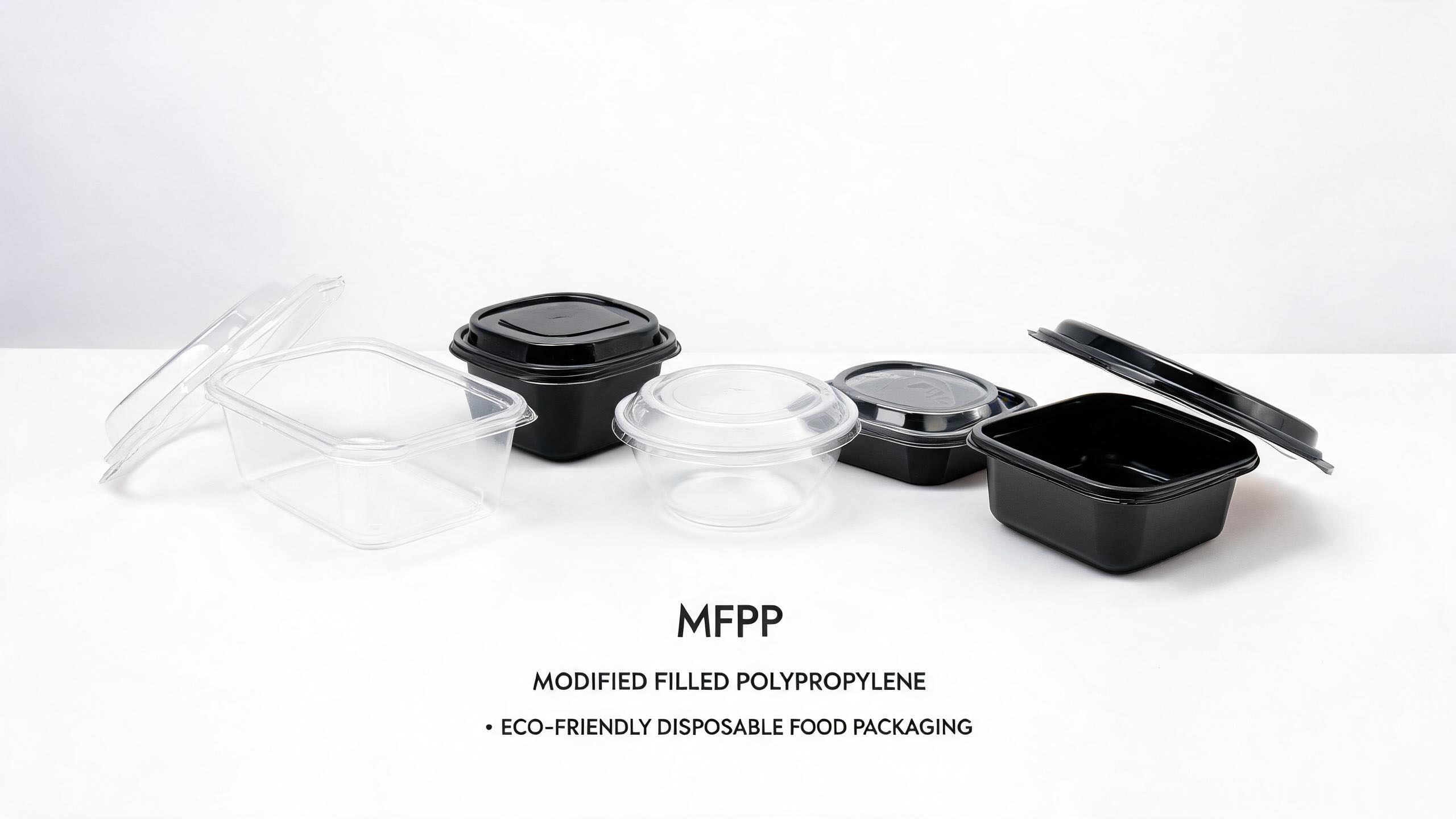
If you have ever ordered takeout or meal delivery, chances are your food arrived in a sturdy, black or white hinged container that survived the trip without cracking or leaking. That container was likely made of MFPP — one of the most widely used materials in modern foodservice packaging. But what exactly is MFPP, and why has it become the go-to choice for restaurants, ghost kitchens, and food delivery programs around the world?
In this guide, we will break down everything you need to know about MFPP material — what it is made of, its key properties, how it compares to other packaging options, and why it matters for your business.
What Does MFPP Stand For?
MFPP stands for Mineral Filled Polypropylene. It is a composite material created by blending standard #5 polypropylene (PP) resin with finely ground natural mineral fillers — most commonly calcium carbonate (limestone) or talc. The mineral filler typically makes up 20% to 50% of the material by weight, with around 40% being a common commercial specification.
The base resin remains standard polypropylene, which is FDA-regulated for food contact under 21 CFR 177.1520. MFPP containers carry the #5 resin identification code, the same as conventional polypropylene.
Key Properties of MFPP Material
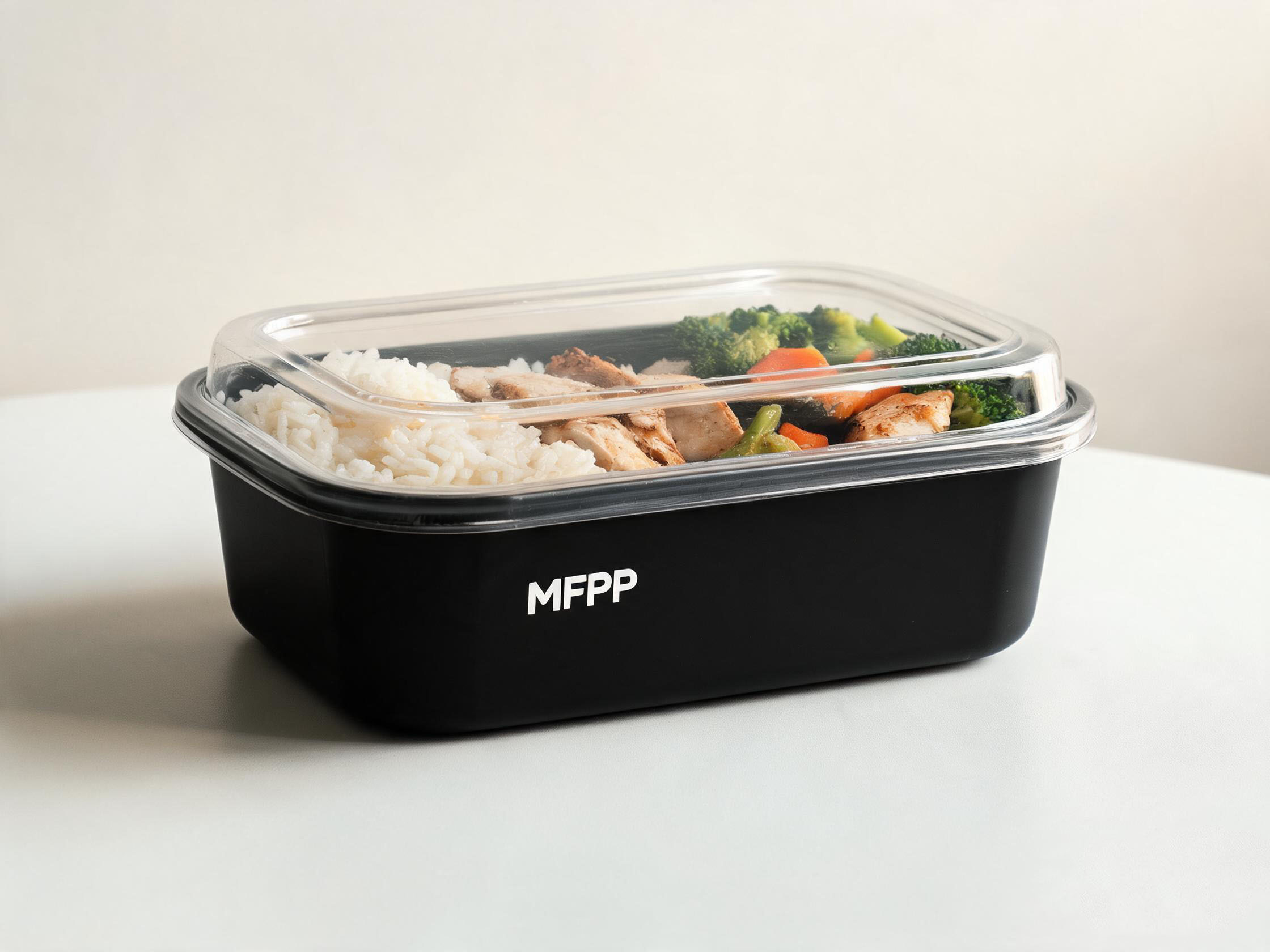
MFPP is engineered specifically for the demands of foodservice packaging. The addition of mineral fillers enhances several properties that matter for takeout and delivery:
1. Superior Rigidity and Cut Resistance
Mineral particles stiffen the polymer matrix, making MFPP containers significantly more rigid than standard PP of the same wall thickness. They resist flexing, cracking, and puncturing — essential for transporting heavy, saucy, or sharp-edged foods.
2. Excellent Heat Resistance
MFPP is designed for microwave reheating. The mineral fillers raise the material heat-deflection temperature, allowing containers to maintain their shape at temperatures up to 250F (121C). Most MFPP containers are certified microwave-safe, making them ideal for customers who reheat their takeout.
3. Chemical Resistance
MFPP exhibits excellent chemical inertness. It can withstand acidic and alkaline solutions (pH 1-12), resists oil penetration for over 2,000 hours, and shows organic solvent swelling rates below 0.5%. This means your containers will not degrade or leach when in contact with acidic foods, oils, or sauces.
4. BPA-Free and Phthalate-Free
Polypropylene is FDA-compliant for food contact, contains no BPA, and is phthalate-free. This makes MFPP a safe choice for food packaging across all categories.
5. Dimensional Stability
MFPP is less prone to deformation from temperature changes or external forces. This ensures that lid designs maintain a precise fit and that containers stack securely without warping.
How MFPP Is Used in Food Packaging
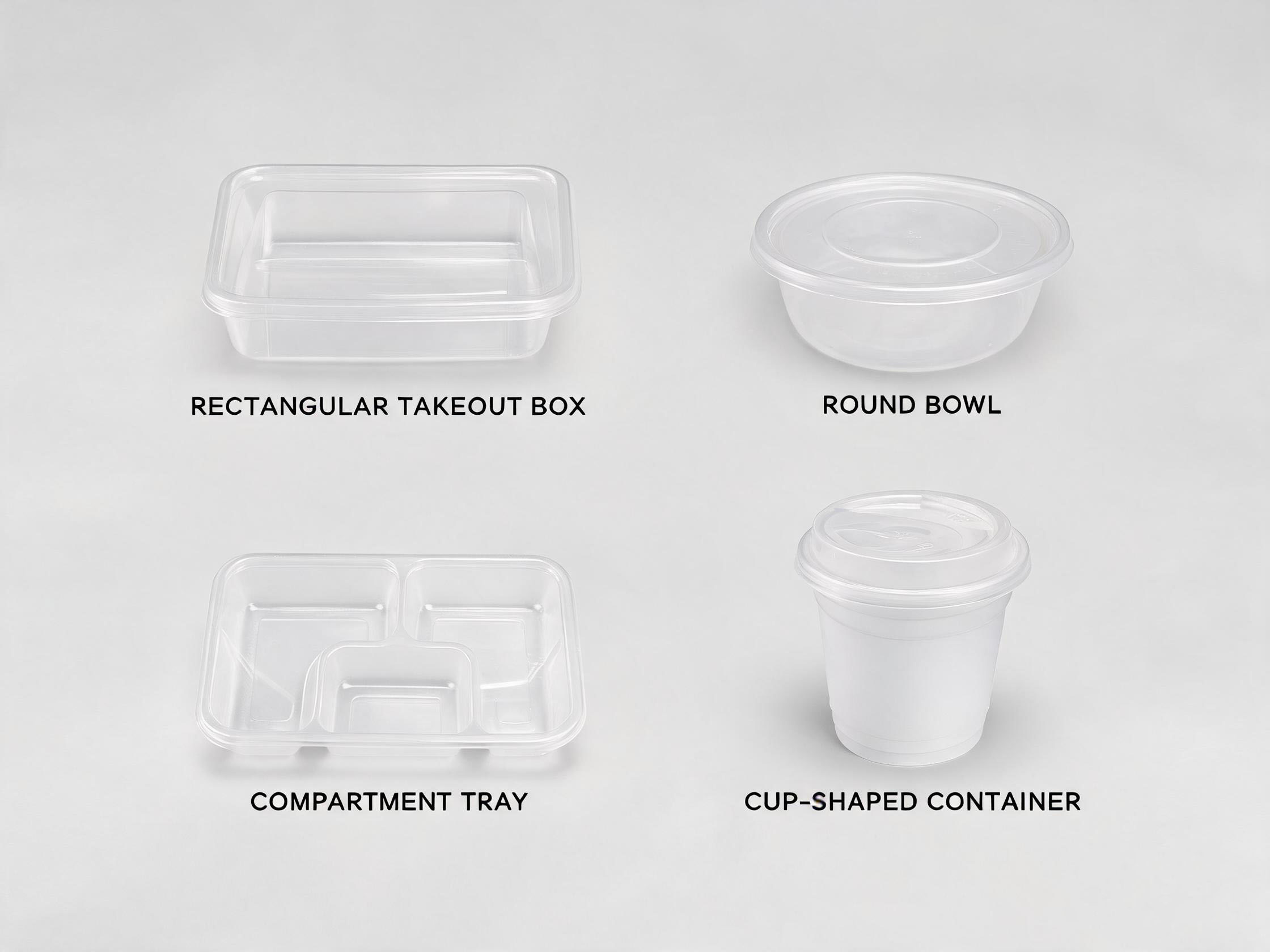
MFPP is primarily used in disposable hinged takeout containers (clamshells), but its applications extend well beyond that. Common MFPP products include:
- Single-compartment clamshells — for sandwiches, sides, and single portions
- Multi-compartment clamshells (2 or 3 compartments) — for plated-style entrees with sides kept separate
- Shallow vented containers — with SmartVent lid systems that allow steam to release, keeping food hot and crispy
- Round and rectangular food containers — for meal prep and food storage
- Bowls and cups — for soups, salads, and wet foods
MFPP containers come in black and white, with black being the most common in the restaurant supply market. Many feature positive-locking hinges, full-perimeter sealing systems, and stackable designs optimized for delivery logistics.
Primary applications: Restaurant delivery, fast-casual chains, airline and railway catering, central kitchens, and customized gift packaging.
Is MFPP Eco-Friendly and Recyclable?
This is one of the most important questions for businesses evaluating packaging sustainability. The answer is nuanced.
The Sustainability Advantage: Less Plastic
The primary environmental benefit of MFPP is resin reduction. By replacing 20-50% of petroleum-based polypropylene with natural mineral fillers, MFPP containers use significantly less plastic per unit than conventional PP containers. A 40% mineral-filled container displaces nearly half its plastic content with naturally occurring minerals.
Recyclability: Complicated
Technically, MFPP containers carry the #5 PP resin code and are recyclable in principle. However, the mineral fillers create practical challenges:
- Density issues: Unfilled PP has a density of 0.90-0.92 g/cm3 and floats in water. Mineral fillers are significantly denser, and high filler loads can push a container density above 1.0 g/cm3, causing it to sink in float-sink recycling tanks — where it would be categorized as non-recyclable.
- Color complications: Most MFPP containers are black, and dark packaging has low near-infrared reflectance, making it difficult for NIR optical sorters in recycling facilities to identify and sort them correctly.
Not Compostable
MFPP is a plastic-based material and does not biodegrade in commercial or home composting. If your municipality mandates compostable packaging, MFPP does not qualify.
MFPP vs. Other Packaging Materials
How does MFPP compare to other common food packaging materials? Here is a side-by-side breakdown:
| Attribute | MFPP | Standard PP (#5) | EPS Foam | Bagasse (Molded Fiber) |
|---|---|---|---|---|
| Cost | Low-moderate | Moderate | Lowest | Moderate-high |
| Rigidity | Excellent | Good | Poor | Good (softens when wet) |
| Heat tolerance | Up to 250F | ~250F | Low (deforms) | High |
| Microwave safe | Yes | Yes | No | Generally yes |
| Recyclable | Complicated | Yes (#5) | Rarely | No (compostable) |
| Compostable | No | No | No | Yes |
| Regulatory risk | Low | Low | High (banned in many areas) | Low |
Advantages of MFPP for Disposable Food Containers
So why choose MFPP for your food packaging? Here are the key advantages:
- Superior rigidity and cut resistance — MFPP containers resist flexing, cracking, and puncturing better than standard PP or foam, making them ideal for heavy, saucy foods and delivery scenarios.
- Excellent microwave reheating — The mineral fillers improve heat-deflection performance, allowing containers to hold their shape during typical reheating where foam would deform.
- Lower resin content — A 40% mineral-filled container uses significantly less petroleum-based plastic, reducing fossil fuel dependency.
- Stackable and leak-resistant — MFPP maintains structural integrity during stacking and transport, and sealing designs help prevent spills.
- Premium appearance — The matte/frosted texture looks more premium than foam and is suitable for printing and brand customization.
- Cost-to-performance ratio — MFPP typically prices between foam and premium bagasse, offering excellent value for hot entree delivery.
- Low regulatory exposure — Unlike EPS foam, which is banned or restricted in many jurisdictions, MFPP faces minimal regulatory risk.
Conclusion
MFPP (Mineral Filled Polypropylene) has earned its place as a workhorse material in foodservice packaging. By blending polypropylene with natural mineral fillers, manufacturers have created a material that offers superior rigidity, excellent heat resistance, and reduced plastic content — all at a competitive price point.
While its recyclability is complicated by density and color sorting challenges, the front-end resin reduction represents a meaningful sustainability improvement. For restaurants and food delivery operations that need durable, microwave-safe, cost-effective containers, MFPP remains one of the best options on the market.
As the packaging industry continues to evolve, MFPP serves as a bridge — offering better performance and lower plastic content than conventional foam or PP, while complementing future innovations in compostable and fully recyclable packaging solutions.